

By
Knowledge Coop
•
May 19, 2026


Every sales rep is different and leading them means understanding how they are best motivated, how they learn, and what makes them tick.
Savvy managers know that performance problems rarely come from one place. Some people lack motivation, while others lack skills. Some people are thriving and simply need support. A few sales people may not belong in sales at all.
A simple but powerful way to evaluate salespeople is by measuring their effort and their sales skills. When you map those together, four distinct quadrants emerge and each one requires a completely different coaching approach.
Watch this video where SVP, Director of Residential Sales Strategy Justin Tucker at Fidelity National Financial shares his four-quadrant approach to training salespeople.
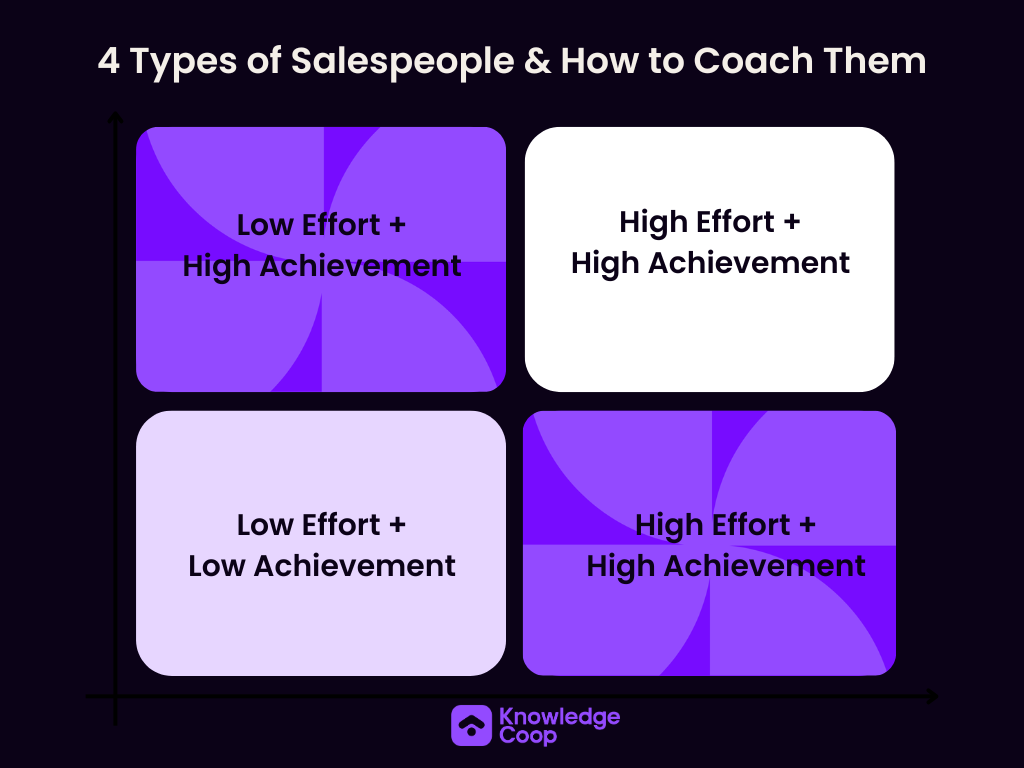
These are top performers. They work hard, execute consistently, close deals, and produce results. They don’t need micromanagement. In fact, too much interference can slow them down. The best thing a leader can do for this group is:
These sales reps are already proving they can win. Leadership becomes less about correction and more about empowerment. If you’re managing someone in this quadrant, your role is to help them go farther, not to constantly evaluate whether they’re doing enough.
This is the danger zone. These reps are neither producing results nor demonstrating the effort required to improve. They aren’t making enough calls, building pipeline, learning, or showing urgency. In many cases, this isn’t a training issue, it’s a fit issue.
Sales is demanding. Even inexperienced reps can often improve if the effort is there. But when both motivation and performance are missing, long-term success becomes unlikely.
Many experienced leaders will tell you that it’s very rare to see someone move from low effort and low achievement into a top-performing quadrant.
That doesn’t mean people can’t change. But it does mean leaders need to recognize when coaching has turned into wishful thinking.
This quadrant can be frustrating because the potential is obvious. These reps know how to sell. They can close deals, build relationships, and deliver results. But they aren’t operating at full capacity.
Maybe activity levels are inconsistent. Or follow-up slips. Maybe they rely too heavily on natural ability instead of discipline. This is where motivation matters most.
The conversation with these reps often sounds like:
The goal isn’t to rebuild capability; it’s to reconnect them to purpose, incentives, growth, or accountability. Sometimes these reps are burned out or bored. They might simply need a new challenge.
But if their engagement level rises, their performance ceiling is often extremely high.
These are often the easiest reps to root for. They’re grinding and putting in the hours. They care deeply. But the outcomes aren’t matching the effort.
This is where strong leadership and training can make a massive difference.
Instead of questioning commitment, leaders should focus on diagnosing gaps:
These reps usually don’t need motivation. They need clarity, coaching, repetition, and skill development.
They should be encouraged, not discouraged. Effort without results can feel defeating over time. Great managers recognize the commitment first while helping improve execution.
This framework matters because every sales quadrant requires a different response. A rep struggling from lack of skill should not be coached the same way as someone struggling from lack of motivation. Top performers shouldn’t be managed like underperformers.
When leaders fail to distinguish between these differences, coaching becomes generic. This kind of coaching rarely changes behavior.
The best sales managers diagnose first, then develop a customized plan accordingly.
The mistake many managers make is assuming every struggling salesperson needs the same solution which includes more pressure, more accountability, more training, and more meetings.
But great sales leadership is about diagnosis before direction.
A rep with strong effort but weak results needs coaching and skill development. A talented rep with low engagement needs motivation and purpose. High performers need autonomy and support. And sometimes, the hardest truth is recognizing when someone is simply in the wrong role.
When leaders fail to recognize these differences, coaching becomes generic and generic coaching rarely changes behavior.
The best sales managers understand that leadership is not about managing everyone equally. It’s about leading people effectively based on what they actually need.
That’s what creates growth and builds trust. Ultimately, that’s what turns a collection of sales reps into a high-performing sales team.