By
Justin Tucker
•
August 20, 2026


You’ve probably heard the question before: “What’s your personal brand?”
It’s become standard advice for professionals trying to stand out, especially in relationship-driven industries like mortgage, real estate, and title.
But I think we’ve been using the wrong word.
Brands belong to companies. People have identities.
A personal brand is often something we try to construct. An identity is something we uncover and share. That distinction matters because people don’t build relationships with logos, taglines, or perfectly polished social media feeds. They build relationships with other people.
If you work in mortgage, real estate, title, or another relationship-driven business, your greatest competitive advantage may not be a polished personal brand at all.
It’s being memorable, relatable, and authentically yourself.
Your identity is what people think about when they hear your name. It’s the combination of your experiences, interests, values, expertise, personality, and quirks that makes you recognizable and memorable.
For a mortgage, that might include your professional expertise, but it shouldn’t stop there.
Maybe people know you as the loan officer who loves college football. The title rep who knows every great restaurant in town. The real estate agent who coaches Little League. The mortgage professional who can explain complicated topics without making people feel overwhelmed.
Those details create opportunities for connection.
The problem is that many professionals hide those parts of themselves the moment they start marketing.
They put on their ‘marketing hat’ and suddenly become more polished, promotional, and corporate.
But that’s rarely how real relationships are built.
Why do we market and sell to people in ways we don’t like being marketed and sold to ourselves?
If you scroll past overly promotional content every day, there’s a good chance your audience does too.
Personal branding often focuses on how you want to be perceived. Identity starts with who you actually are.
That makes identity especially powerful in relationship-driven businesses, where trust and familiarity influence who people choose to work with and refer.
Your expertise still matters. Your professionalism still matters. But expertise alone rarely makes someone memorable.
People remember stories, shared interests, personality, values, and experiences. Identity gives people more reasons to remember you and more opportunities to connect with you.
Start with a simple exercise. Open the Notes app on your phone and create a note called Identity. Start writing down everything that makes you, you.
For example, maybe you:
Nothing is too small.
Your identity list can include hobbies, interests, experiences, skills, values, causes you care about, things you’re learning, places you love, traditions, professional expertise, and even the little quirks your friends associate with you.
And don’t treat this as a one-time exercise.
Your identity list should be a living document.
As you discover new interests, have new experiences, or learn something about yourself, add it. Whenever you’re wondering what to post on social media or talk about with your network, revisit the list.
Chances are there’s a part of your identity you haven’t shared in a while.
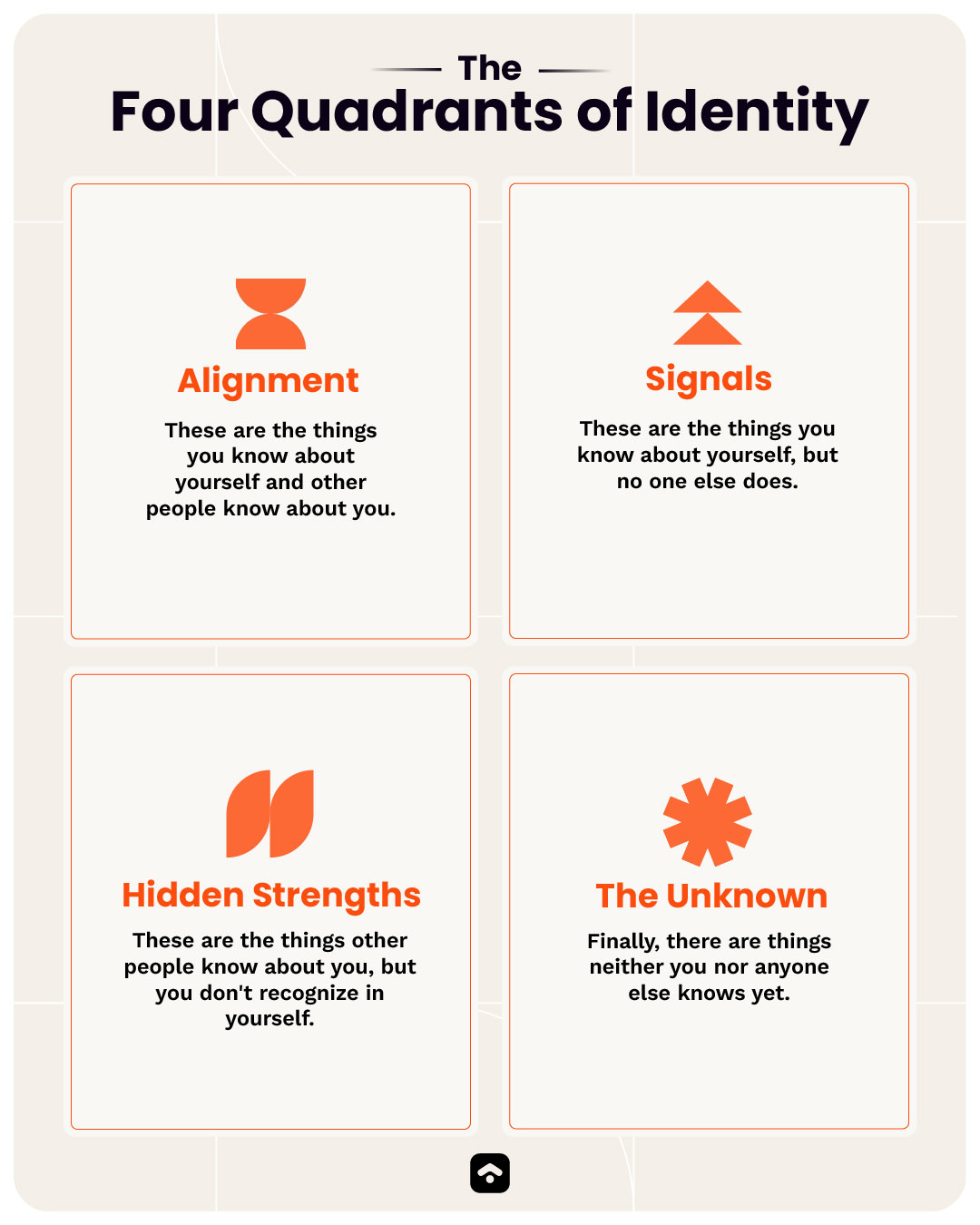
I like to think about professional identity through four quadrants: Alignment, Signals, Hidden Strengths, and the Unknown.
Each quadrant represents the relationship between what you know about yourself and what other people know about you.
Alignment includes the things you know about yourself that other people also recognize in you.
This is where connection happens. Maybe people know you’re passionate about helping first-time homebuyers. Maybe they know you love hiking, have an encyclopedic knowledge of college football, or always know the best restaurant to recommend.
Those shared points of knowledge create conversation starters. Conversation creates relationships.
The goal is to spend as much time in the alignment quadrant as possible.
Signals are parts of your identity you recognize in yourself but haven’t shared with other people.
Maybe you’re deeply involved in your community or you’re an incredible cook. Maybe you’ve run three marathons or you restore old cars on weekends. If you never share those parts of yourself, other people never have the opportunity to connect with you over them.
That doesn’t mean sharing every detail of your life online. It means giving people authentic signals about who you are.
Every meaningful signal creates an opportunity to move something from this quadrant into alignment.
Hidden strengths are qualities other people recognize in you that you may not recognize in yourself.
This can be the most revealing quadrant. Ask a few people you trust:
Their answers may surprise you. Not because they reveal a completely different person, but because they may identify patterns you’ve never consciously connected. Maybe everyone comes to you when they need a complicated idea simplified. Or people see you as a connector. Maybe you’re known for staying calm when a transaction gets difficult.
Those are meaningful parts of your identity, even if you’ve never thought to describe yourself that way.
Once you recognize them, you can begin sharing those strengths more intentionally.
The final quadrant contains the parts of your identity that neither you nor anyone else has discovered yet.
These qualities often emerge through new experiences, challenges, relationships, or unexpected situations.
You can’t manufacture them. You discover them as life unfolds.
And when you do, your identity list grows with you.
Marketing has changed dramatically over the past two decades. Consumers are surrounded by marketing messages every day. Promotional graphics, ads, emails, videos, listing announcements, rate updates, and sales pitches can quickly blend into white noise.
Standing out doesn’t necessarily mean becoming louder.
It means becoming more human.
People don’t stop scrolling simply because another professional shared another promotional graphic. They stop for a story, a lesson, or something useful. People want to see the behind-the-scenes moment or something funny.
These moments create pattern disruption which leads to connection.
No. Building an identity doesn’t mean abandoning professional content. Your expertise is part of your identity too.
The difference is that your profession becomes one dimension of who you are instead of the only thing people ever see.
Share what you know and educate your audience. But give people other reasons to know you, too. Someone may initially follow you because of your mortgage expertise and eventually discover you both love the same football team. Or they may connect with a story about coaching your kid’s baseball team before they ever need a loan.
Months or years later, when they do need someone in your industry, they already know who comes to mind. That’s the power of identity.
The most successful professionals don’t have to treat themselves like companies. They let people see who they are. They share what they care about and demonstrate what they know. They tell stories and develop familiarity and trust long before someone needs their product or service.
Over time, those seemingly small moments compound. You become more than a job title. You become someone people recognize. You become someone they remember and trust. And eventually, someone they call.
So stop worrying so much about building a personal brand. Start sharing your identity. Because in a business built on relationships, being remembered for who you are is far more powerful than being remembered for how well you marketed yourself.
A personal brand generally describes how a professional intentionally presents and positions themselves to an audience. Identity is broader: it includes the experiences, interests, values, expertise, personality traits, and characteristics that make someone who they are.
Focusing on identity can make professional marketing feel more authentic and relatable.
Mortgage, real estate, and title are relationship-driven industries. Clients and referral partners often choose professionals they know, remember, and trust.
Sharing more dimensions of your identity can create common ground and help relationships develop before a transaction begins.
An identity list can include hobbies, professional expertise, interests, values, life experiences, favorite activities, community involvement, skills, traditions, personality traits, and other characteristics that genuinely represent you.
The four quadrants are Alignment, Signals, Hidden Strengths, and the Unknown.
Alignment represents qualities both you and others recognize. Signals are things you know about yourself but others don’t. Hidden strengths are qualities others recognize that you may overlook. The unknown represents qualities that have yet to be discovered.
Use your identity list as a source of content ideas. Instead of posting only promotional or industry content, rotate through your interests, expertise, experiences, stories, hobbies, and observations. The goal isn’t to share everything about your life. It’s to give people authentic opportunities to know and remember you.
Justin Tucker empowers FNTG’s sales associates and the Realtor community at the intersection of technology, marketing, and strategy. He collaborates with industry leaders to build comprehensive business plans designed to drive meaningful growth.
As a strategist, Justin believes in breaking down the silos between customer experience, marketing, technology, and operations to create plans that understand both the art and science of selling. Through techniques focused on gamification, common language, skill development, and repeatable methodologies, he works to forge new paths in an industry that can sometimes be slow to change.
In 2017, HousingWire named Justin to its class of Rising Stars in the real estate industry. He has spoken at industry events including Inman Connect and NS3. In 2024, HousingWire recognized him with a Tech Trendsetter award for his work pushing the boundaries of gamification, artificial intelligence, and consumer-centric technology.
Justin holds a Bachelor of Science in Psychology from Oregon State University and an MBA with concentrations in Marketing and Real Estate from Marylhurst University.