By
Knowledge Coop
•
October 15, 2026


Like any industry, the mortgage world has a language of its own. Acronyms and terms like MLO, NMLS, DTI, LTV, AUS, LE, CD, Conventional, FHA, VA, Escrow, and Underwriting can be overwhelming when you’re new to mortgage.
Remember, you don't need to learn everything at once.
This is a starting point for people who are new to the mortgage industry. This guide covers the people, terminology, loan programs, regulations, and processes you'll encounter as you learn what it means to work as a mortgage loan originator.
Use it as your foundation, then dig deeper into each topic as you build your mortgage knowledge.

A mortgage loan originator (MLO) takes a residential mortgage loan application and offers or negotiates the terms of a residential mortgage loan for compensation or gain.
That's the regulatory definition. The everyday job is a little easier to understand. MLOs help educate and navigate people throughout the process of financing a home.
According to the Consumer Financial Protection Bureau (CFPB), depending on their role and organization, an MLO may:
An MLO is a salesperson, an educator, and a guide through a highly regulated financial transaction. That means learning the job requires more than understanding how to calculate a mortgage payment. You need to understand the entire ecosystem that is built around the loan. Still considering the field? Here are 5 Reasons You Should Work in Mortgage.
When you’re starting this journey, you should first ask: Should you become an MLO in 2026?
If you’ve considered the pros and cons of this career and are still interested, the path you choose depends partly on where and how you work. MLOs working for state-licensed mortgage companies must generally meet state licensing requirements administered through the Nationwide Multi-state Licensing System & Registry (NMLS).
Under the federal SAFE Act minimum requirements, state-licensed MLOs must complete at least 20 hours of NMLS-approved pre-licensure education (PE). That education includes federal law and regulations, ethics, nontraditional mortgage lending, and additional mortgage origination education. States may require additional education or impose other licensing requirements.
MLOs employed by federally regulated depository institutions follow a federal registration process rather than the same state licensing process.

For mortgage loan officers, PE and CE happen at different points in the licensing process.
Pre-Licensing Education (PE) is education you complete before obtaining a mortgage loan originator license. Under the SAFE Act, MLOs generally need 20 hours of NMLS-approved federal PE, and some states require additional state-specific PE. An MLO may also need state PE when adding a license in another state.
Continuing Education (CE) is education that licensed MLOs complete each year to maintain and renew their licenses. The standard SAFE requirement is eight hours annually: three hours of federal law, two hours of ethics, two hours of non-traditional mortgage lending, and one hour of elective education. States can have additional requirements.
PE gets you licensed. CE keeps you licensed.
For Knowledge Coop specifically, that means your 20-Hour SAFE Federal PE and State PE offerings are aimed at people entering the industry or expanding their licenses, while Federal and State CE are for already-licensed MLOs completing their annual renewal requirements.
Once the licensing is completed, what could the first 90 days as an MLO look like?
Days 1–30: Learn the Business
Your first month is about creating a strong foundation. Learn your company’s loan process, loan operating system (LOS), and customer relationship management (CRM), get familiar with the available loan products, and understand what happens at each stage from application through closing. Spend time shadowing experienced loan officers, processors, and other team members. Start practicing borrower conversations, learn how to explain common mortgage terms clearly, and create a list of internal resources and people you can turn to when questions come up.
Days 31–60: Start Building Your Business
Now it’s time to put what you’re learning into practice. Start reaching out to potential referral partners, reconnect with your existing network, and develop a consistent routine for prospecting and follow-up. Practice taking applications, reviewing borrower scenarios, asking better discovery questions, and explaining financing options. Set weekly goals for conversations, follow-ups, and new relationships so you can begin creating a pipeline instead of waiting for business to find you.
Days 61–90: Create a Repeatable Routine
By the third month, focus on turning your early efforts into habits. Track which activities are creating conversations and opportunities, keep following up with borrowers and referral partners, and refine how you manage your day. Stay involved with loans as they move through processing, underwriting, and closing so you understand what can keep a transaction moving or slow it down. At 90 days, you should have a clearer picture of who you want to serve, where your business can come from, and the daily and weekly activities you need to repeat to keep growing.
One of the first concepts to understand about mortgage lending is that nobody gets a loan to the closing table alone. A single transaction can involve a surprisingly large group of people.
Here’s a list of some of the people that are part of the process.
Borrower: The person applying for the mortgage and ultimately responsible for repaying the loan.
Mortgage Loan Originator (MLO): The MLO works directly with the borrower during the origination process, helping them understand financing options, complete the application, provide necessary information, and move through the transaction.
Loan Processor: Processors help organize the loan file, gather documentation, verify information, and prepare the file for underwriting.
Mortgage Underwriter: The underwriter evaluates the loan against applicable requirements and determines whether it meets the standards necessary for approval.
Appraiser: An appraiser provides an independent opinion of the property's value for the lending transaction.
Title and Settlement Professionals: Depending on the state and transaction, title companies, escrow companies, settlement agents, or attorneys may help research ownership, address title issues, manage funds, prepare documents, and facilitate closing.
Loan Servicer: After closing, the mortgage servicer handles ongoing administration of the loan, including collecting payments and managing applicable escrow accounts.

A mortgage is a loan used to finance real estate, with the property serving as collateral for the debt. The borrower agrees to repay the amount borrowed plus interest according to the terms of the loan.
While every transaction is different, a mortgage generally moves through several major stages:
Application → Processing → Underwriting → Approval → Closing → Servicing
Understanding this lifecycle gives you a framework for almost everything else you'll learn.
Application - The process begins when a borrower provides information about their finances and the property involved in the transaction.
Processing - Documentation is collected, organized, reviewed, and prepared for underwriting.
Underwriting - The loan is evaluated against applicable program, investor, lender, and regulatory requirements.
Approval - The underwriter may approve the loan, often subject to additional conditions that must be satisfied.
Closing - Final loan documents are prepared and signed, applicable funds are transferred, and the mortgage transaction is completed.
Servicing - After closing, the servicer administers the mortgage and collects payments from the borrower.
Mortgage qualification involves looking at multiple pieces of the borrower's financial picture. You'll spend a significant part of your mortgage career learning how these pieces interact.
Income
Income helps determine a borrower's ability to repay the mortgage. But qualifying income isn't always the same as the amount someone says they earn.
Different requirements can apply to salary, hourly wages, overtime, bonuses, commissions, self-employment income, rental income, and other income sources.
Assets
Assets can help borrowers cover down payments, closing costs, reserves, and other transaction requirements. Common assets can include checking and savings accounts, investments, retirement accounts, and eligible gift funds.
Credit
Credit history provides information about how a borrower has managed debt. Credit scores matter, but they're only part of the picture. Mortgage lending can also involve evaluating payment history, outstanding debts, recent credit activity, significant derogatory events, and other credit characteristics.
Debt
Existing obligations affect how much additional debt a borrower may be able to take on. That is where one of the most common mortgage calculations enters the picture: debt-to-income (DTI) ratio.
Property
Mortgage lending isn't only about qualifying the borrower. The property securing the mortgage must also meet applicable requirements. Depending on the transaction, that can involve an appraisal, title review, insurance, property eligibility requirements, and other considerations.

One of the biggest learning curves for a new MLO is understanding that there isn't one universal mortgage. Different loan programs have different eligibility requirements, features, and guidelines.
Four categories you'll encounter frequently are conventional, FHA, VA, and USDA mortgages.
A conventional mortgage isn't insured or guaranteed by a federal government agency. You will frequently encounter Fannie Mae and Freddie Mac when learning about conventional lending. These government-sponsored enterprises purchase mortgages that meet their respective requirements and play a major role in the secondary mortgage market.
The Federal Housing Administration (FHA) provides mortgage insurance on loans made by FHA-approved lenders. FHA loans have their own requirements involving borrower eligibility, mortgage insurance, property standards, and underwriting.
The U.S. Department of Veterans Affairs (VA) guarantees a portion of eligible home loans made by private lenders to qualifying veterans, service members, and certain surviving spouses. VA loans have their own eligibility, entitlement, property, underwriting, and funding requirements.
The U.S. Department of Agriculture (USDA) supports home loan programs intended to promote homeownership in eligible rural areas. Eligibility can involve the borrower, household income, property, location, and specific USDA program.
There isn't a single loan program that's universally best. An MLO's job is to understand the available options and applicable requirements so borrowers can receive accurate information about financing for which they may qualify.
A mortgage file can contain a lot of documents. When you're starting out, as a new MLO two forms deserve particular attention: the Loan Estimate and Closing Disclosure.
The loan estimate is a standardized three-page disclosure that provides information about the mortgage a consumer has applied.
It includes information about estimated:
For transactions subject to the applicable federal requirements, lenders generally must provide the loan estimate within three business days after receiving the six pieces of information that constitute an application for these purposes.
The closing disclosure provides final details about the mortgage transaction, including loan terms, projected payments, and closing costs. For covered transactions, consumers generally must receive the closing disclosure at least three business days before consummation.
Learning how to read these documents will help you understand both the mortgage itself and the consumer's experience of the transaction.
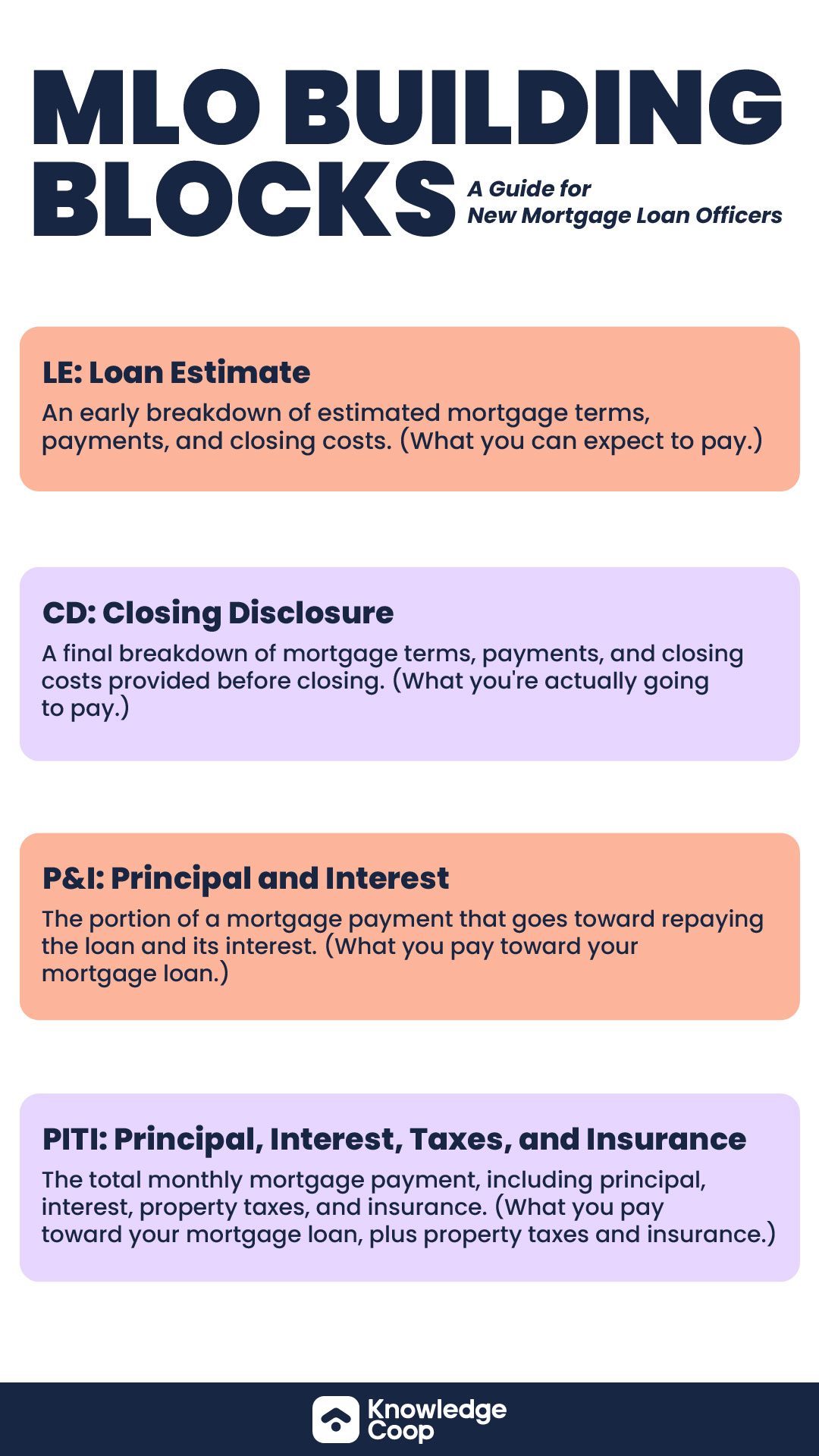
Mortgage people love acronyms. Here are some you will hear almost immediately:
APR: Annual Percentage Rate
AUS: Automated Underwriting System
CD: Closing Disclosure
CLTV: Combined Loan-to-Value
DTI: Debt-to-Income
ECOA: Equal Credit Opportunity Act
FHA: Federal Housing Administration
FHFA - Federal Housing Finance Agency
FHLMC - Freddie Mac (Federal Home Loan Mortgage Corporation)
FNMA - Fannie Mae (Federal National Mortgage Association)
LE: Loan Estimate
LO: Loan Officer
LOE or LOX: Letter of Explanation
LTV: Loan-to-Value
MLO: Mortgage Loan Originator
NMLS: Nationwide Multistate Licensing System & Registry
P&I: Principal and Interest
PE: Pre-Licensure Education
PITI: Principal, Interest, Taxes, and Insurance
PMI: Private Mortgage Insurance
RESPA: Real Estate Settlement Procedures Act
SAFE Act: Secure and Fair Enforcement (from the Secure and Fair Enforcement for Mortgage Licensing Act of 2008)
TILA: Truth in Lending Act
TRID: TILA-RESPA Integrated Disclosure
USDA: U.S. Department of Agriculture
VA: U.S. Department of Veterans Affairs
Don't worry about memorizing the entire mortgage alphabet on your first day. You will learn these quickly because you will hear them constantly.
Mortgage lending is highly regulated. You don't need to become a compliance expert before your first day, but you do need to understand that compliance isn't separate from the MLO's job. It affects advertising, applications, disclosures, communication, documentation, consumer information, loan terms, and many other parts of origination. Some major federal laws and regulations you'll encounter include:
Truth in Lending Act (TILA) establishes consumer protections related to credit and requires disclosures about certain costs and terms.
The Real Estate Settlement Procedures Act (RESPA) addresses areas of the residential real estate settlement process, including disclosures and restrictions involving certain settlement practices.
The Equal Credit Opportunity Act (ECOA) prohibits creditors from discriminating against applicants in credit transactions based on protected characteristics established by law.
Fair Housing Act prohibits housing discrimination based on protected characteristics established by federal law.
Secure and Fair Enforcement for Mortgage Licensing Act (SAFE)
This is a federal law passed in 2008 that created nationwide standards for mortgage loan originator licensing and registration. It requires state-licensed MLOs to meet minimum requirements such as pre-licensing education, testing, background checks, and continuing education, and it established the framework for the Nationwide Multi-State Licensing System & Registry (NMLS). Its broader purpose is to strengthen consumer protection and accountability in mortgage lending.
What Are Fannie Mae and Freddie Mac?
You will hear these names almost immediately in conventional mortgage lending. Fannie Mae and Freddie Mac don't typically originate mortgages directly for individual homebuyers. Instead, they operate in the secondary mortgage market, purchasing eligible mortgages from lenders. This helps provide liquidity that lenders can use to make additional mortgage loans.
Both organizations publish extensive requirements covering topics such as:
Their selling guides will eventually become important resources in your mortgage career. You don't need to memorize them, but you will want to learn how to find and interpret the information you need.
An automated underwriting system (AUS) evaluates loan information against applicable underwriting criteria and produces findings that help lenders evaluate mortgage applications. Two names you'll commonly encounter are:
Desktop Underwriter (DU) from Fannie Mae and Loan Product Advisor (LPA) from Freddie Mac. An AUS doesn't eliminate the need for accurate information, documentation, underwriting judgment, or compliance.
For a new MLO, the bigger lesson is this: The quality of the information going into the loan matters.

Closing might feel like the finish line when you're originating the loan. For the borrower, it's the beginning of potentially decades of mortgage payments. After origination, mortgages enter the world of servicing and the secondary mortgage market.
A mortgage servicer handles ongoing administration of the loan. That can include collecting monthly payments, administering escrow accounts, sending statements, handling certain borrower requests, and managing other servicing responsibilities.
Lenders don't necessarily keep every mortgage they originate. Loans may be sold into the secondary market, including to investors or entities such as Fannie Mae and Freddie Mac.
Understanding this part of the business helps explain something that can initially be confusing:
The company that originates the loan, the company that owns the loan, and the company that services the loan aren't necessarily all the same company.
One of the most important building blocks in mortgage isn't knowing every answer. It's knowing where to look. Mortgage requirements change. Programs, loan limits, state requirements, and company policies change. Start building the habit now of seeking out reliable primary sources.
Here are some of the most useful resources:
NMLS - Licensing, testing, education, state requirements, and MLO registration information.
Consumer Financial Protection Bureau (CFPB) - Federal consumer financial regulations, mortgage disclosures, consumer resources, and regulatory guidance.
Fannie Mae - Conventional mortgage eligibility, underwriting, and selling requirements.
Freddie Mac - Conventional mortgage eligibility, underwriting, and seller/servicer requirements.
HUD and FHA - Official FHA program requirements and guidance.
U.S. Department of Veterans Affairs - Official VA home loan eligibility and program guidance.
USDA Rural Development - Official information about USDA housing programs.
Don't forget your organization's own policies and procedures. A loan may satisfy the basic requirements of a mortgage program while still being subject to additional investor or company requirements.
In addition to these acronyms, terms, agencies, and processes, don’t forget to start paying attention to the economy. An important part of your new job is translating the market to potential buyers. News headlines can cause confusion and customers will expect you to start understanding what drives affordability and learn how to explain that information clearly. It’s important that New MLOs Don’t Ignore These Key Economic Indicators.
There is a lot to learn in mortgage. That's not something you need to solve during your first week, month, or even year. Experienced mortgage professionals still look things up. Guidelines change and regulations evolve. Every borrower presents a different financial picture. Occasionally you will encounter a scenario you've never seen before.
That's normal. The goal isn't to memorize the mortgage industry. It’s to understand the fundamentals well enough to recognize what you're looking at, know the questions to ask, and where to find reliable answers.
Simplify the Mortgage Guideline Search with Coop AI. This helpful resource can answer any FHA, VA, USDA, Fannie Mae, and Freddie-Mac mortgage guideline questions with citation-backed answers.
Start your MLO journey with the building blocks by learning the language, understanding the loan process, getting comfortable with the numbers, learning the major programs, and understanding the people involved. Finally, don’t forget to always check your sources.
Setting Goals
Looking for mentorship and guidance on Purpose and Profits? Watch this video Where Founder of MortgageCoach Dave Savage explains why it’s important to focus less on interest rates and more on being valuable to your customers beyond the transaction. Maybe you’re looking for Habits for Success as you begin this career journey. This video is a great way to make elevating your business and sales strategies, expanding your network, and transforming your approach to success part of your daily routine. In this video, VP, Retail Market Leader at Cardinal Financial Eric Wiley discusses goal setting and how assessing your goals is an important part of the process.

Making Connections
Staying connected to your clients is an important skill for successful MLOs. In this video, Guild Mortgage MLO Sara Keller talks about how she makes weekly phone call updates to her clients to share conversations and to position herself as a trusted advisor.
In this video about follow-up sales strategies, Senior MLO at Advantage Mortgage Mark Aalto talks about creating systems as part of a sales follow-up strategy that will set you up for success. He explains that recognizing potential customers’ communication styles (phone, email, text) is a powerful way to make those initial conversations memorable.
Sales Strategies
Michelle Berman-Mikel of Berman Media continues this concept of making valuable connections in this video about strategic prospecting. She explains how to identify the people who can create momentum then following a consistent process in order to get more sales leads.
In this video, Branch Manager at CrossCountry Mortgage David Kammerer shares sales strategies for beginners. “Sometimes, new MLOs have an advantage because they don’t have any previous experience with the market to make comparisons,” said Kammerer. “If you’re starting out, having the right attitude and focusing on your client’s needs is key.”
Even though you are just starting out, it doesn’t hurt to look to the future and consider what kind of leader you could be in the industry. In this video course, How to Become a Vision-Driven Leader, will help you learn how to lead with purpose and make a lasting impact using an established framework developed over decades of leadership coaching.
Are you hoping to create a plan for your career? While you are collecting knowledge and best practices, consider Your Mortgage Career Roadmap: From Licensing to Top Producer.
Looking for more guidance? Read A Guide to Become an NMLS Licensed Mortgage Loan Originator.
Use these resources to continue building your mortgage foundation.